numerology
life reflections
Patterns in Nature: Why I Keep Seeing 13
(And What a Turtle in Maui and a Palm in Chatsworth Taught Me)
I didn’t go to the Maui Ocean Center in summer 2025 expecting a spiritual awakening.
I went expecting: air conditioning, something beautiful behind glass, and maybe a souvenir I absolutely do not need.
And then a sea turtle glided by like it owned the place (because obviously it did), and I found myself doing what I always do when the universe hands me something quietly extraordinary:
I started looking for the pattern.
Specifically, the pattern on its shell.
Which is how I learned I am, apparently, the kind of person who will turn into a human counting device at an aquarium. Cool. Love this journey for me.
The world is not random. It’s just pretending.
Once you start noticing patterns in nature, you can’t unsee them. Spirals. Symmetry. Branching. Waves. Repetition. Order hiding inside what looks like chaos.
One of the most famous patterns is the Fibonacci sequence—yes, the one people casually drop at dinner parties to sound smart (and sometimes it works).
0, 1, 1, 2, 3, 5, 8, 13, 21, 34…
Each number is the sum of the two before it.
In nature, Fibonacci tends to show up when something is growing and packing efficiently—like seeds in a sunflower, the geometry of pinecones, the spirals of succulents. Not because plants are doing math, but because growth follows rules. Space is limited. Sunlight matters. Stability matters. Nature keeps selecting what works.
And then… turtles.
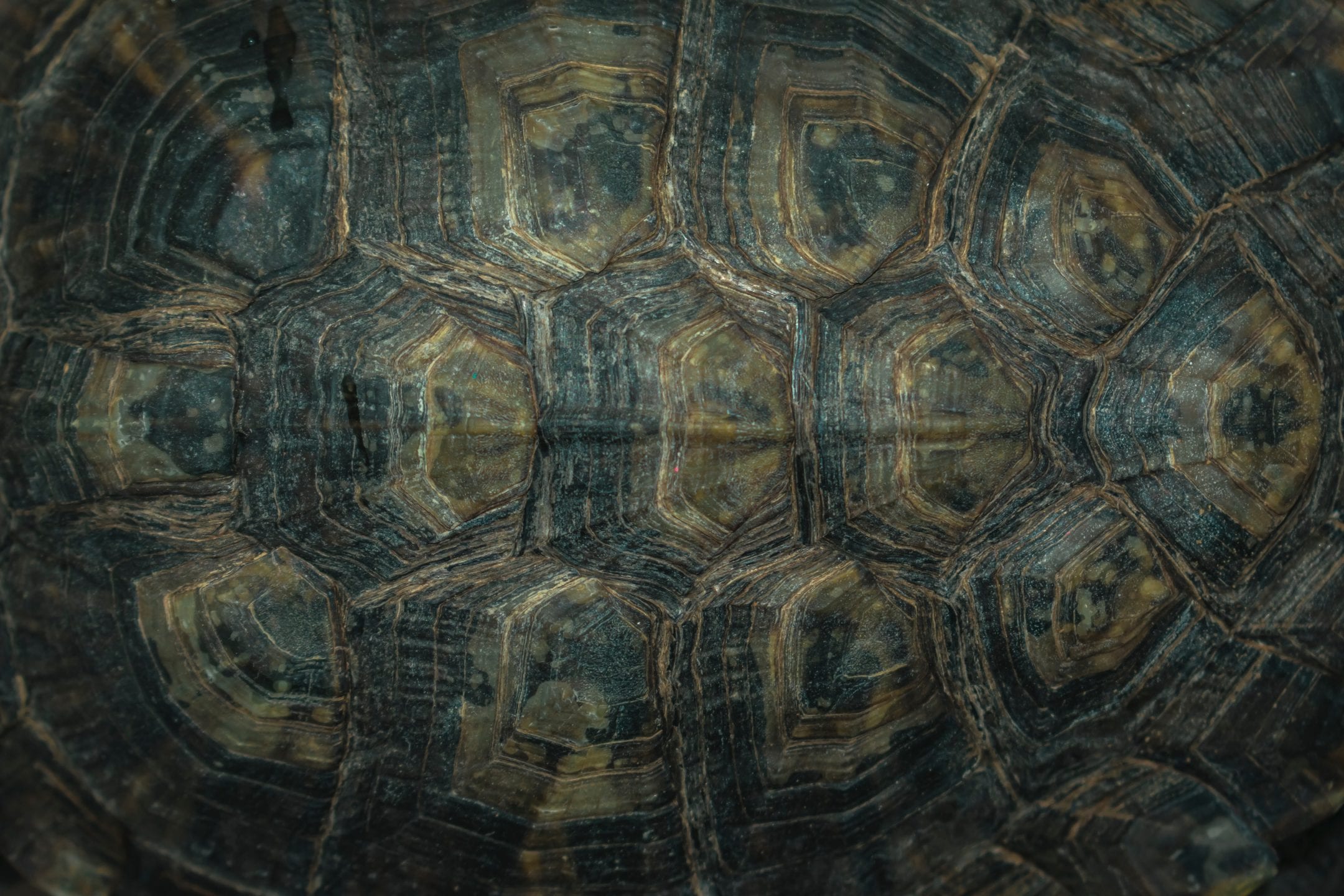
The turtle shell that made me say “Wait… is that 13?”
A turtle shell isn’t a smooth helmet. It’s a mosaic—armor plates called scutes, fitted together like a living puzzle.
On the top shell (the carapace), many turtles commonly have:
5 scutes down the center (the vertebral scutes)
8 scutes along the sides (four pairs of costal scutes)
That’s 5 + 8 = 13.
And yes—13 is Fibonacci.
So there I was, watching a turtle surface in Maui, having a full-on “nature is structured” moment over something most of us glance at and move on from. But once you see it, you can’t not see it.
Because pattern isn’t just decoration in nature.
Pattern is often function.
Myth vs. Truth: “All turtles have 13 squares on their backs.”
Let’s keep the hook and keep it accurate.
MYTH:
“All turtles, no matter the species, have exactly 13 ‘squares’ on their backs.”
TRUTH (and it’s still cool):
Many turtle species commonly have 13 large scutes on the carapace—often arranged as 5 down the center and 8 on the sides. But it’s not universal across every turtle species, and the scutes around the edge (marginals) can vary a lot.
So the accurate—and still satisfying—version is:
Many turtles commonly have 13 large scutes on the top shell, and that 13 comes from 5 + 8 (two Fibonacci numbers).
We keep the magic. We keep the facts. Everybody wins.
Why nature loves “tiles”
A tiled shell is an elite design solution because it has to do something hard:
protect the animal
distribute pressure
resist cracking
allow growth over time
A single solid plate is strong until it fails. A network of plates and seams can flex, adapt, and last.
Nature doesn’t need a brand consultant. It needs engineering that survives.
Are there other animals with 13?
Yes, but with the same rule we’re using for turtles: nature is full of patterns, not guarantees.
Periodical cicadas: some species have a 13-year life cycle (others have 17). That “13” is famous for a reason—nature sometimes uses numbers as timing strategies, not just geometry.
Sea stars: some species can have 13 arms (many have five, but multi-armed sea stars exist). Consider it a bonus “nature is weird” footnote.
Still, turtles are my favorite “13” because you can look at the shell and count it with your own eyes. It’s pattern you can touch with your attention.
Maui to Chatsworth: when a “pattern” is a family landmark
Maui gave me the Fibonacci version of a turtle: calm, ancient, geometric.
Chatsworth gives me something else entirely.
There’s a palm tree at Oakwood Memorial Park in Chatsworth, California that I can pick out instantly—because it’s the only palm tree in the entire cemetery. Which feels statistically impossible in Southern California, where palms are basically part of the operating system. But there it is, standing alone like it has a job.
And honestly? It does.
My maternal great-grandparents Eva and Robert Boggs are buried right under it, along with their son Bill (“William”) Boggs. Eva and Robert planned that. Which means this isn’t just where people ended up. It’s where they chose to be—together, anchored to one living thing that keeps reaching upward.
This is the part where my Gen X brain wants to make a joke, because that’s how we survive. But I also know what it means to stand under one tree and feel a whole family’s story gather around you.
Eva lived to 94. She died in 1982, when I was 16—old enough to really remember her, old enough to understand (at least a little) that time with someone is not the same thing as time guaranteed. I got to know her as a person, not just a name on paper.
Robert died in 1967, the year my brother Curtis was born—and Curtis’s middle name is Robert, because sometimes love shows up as a name you carry forward when the person is gone.
And then there’s Bill.
Bill died tragically in 1947, in a car crash. But he’s also the reason my family ended up in Chatsworth at all. In 1946, after my biological grandfather Charles Crooks—a B-17 pilot—was killed on December 15, 1944, Bill urged them to leave Cleveland Heights, Ohio and come west. Bill wanted to be an actor. Of course he did. He saw a bigger horizon and pulled the family toward it.
Chatsworth: the backdrop behind the palm
Chatsworth sits in the northwest corner of the San Fernando Valley. And when my family arrived, it wasn’t “the Valley” the way people picture it now. It was orange groves as far as you could see—more horizon than hustle, more trees than traffic.
It was also near Spahn Ranch, which is one of those very California sentences that can go in wildly different directions. For a long time it was a working ranch and a filming location for TV westerns—Bonanza, The Lone Ranger, that whole era of dust and hero music.
And then it became something else entirely: the hideout for Charles Manson and his followers. Even though he was arrested in 1969, it still stayed in the air. The idea that something that dark had been a mere six miles away doesn’t exactly fade just because the calendar moves on.
Years later, I was in Washington, D.C. celebrating the inauguration of President Barack Obama, and I ended up having one of those only-in-your-life conversations—with actor Val Kilmer. His father, Eugene, had developed the land where my grandparents built their house. It had once been the Roy Rogers estate.
Val told me he’d lived in Roy’s old house for a time. And then the story took the turn that makes you sit back and blink: his younger brother, Wesley, drowned in the pool at age 15 in 1977 after having an epileptic seizure.
I don’t tell that story to be dramatic (Gen X reflex: understate everything). I tell it because it’s another reminder that places carry patterns, too—light and shadow, reinvention and heartbreak, mythology and real life—all layered on the same ground. And somehow my family’s thread runs right through it.
So when I look at that single palm, I don’t just see a tree.
I see a timeline.
I see grief that didn’t get the final word.
I see decisions made in the middle of heartbreak.
I see a family that kept going—relocating, rebuilding, renaming, re-rooting.
And yes, I see a pattern.
Nature repeats shapes because it’s efficient. Families repeat stories because it’s how we stay connected. Sometimes a pattern isn’t a spiral in a sunflower or 13 scutes on a turtle’s shell.
Sometimes it’s one palm tree in an ocean of headstones, holding a place in the world where your people can always be found.
The point (because there’s always a point)
I love patterns in nature not because I need everything to be “explained,” but because noticing patterns changes how you move through the world.
It slows you down—in a good way.
It wakes you up.
It makes the ordinary feel layered.
And that’s a Live Simply, Give Freely kind of practice: stay curious, stay connected, keep learning—whether what you’re connecting is people, history, grief, growth… or the quiet math of a turtle shell in Maui.
Yes, I’m counting scutes now.
Yes, it’s on brand.
Blogs and Insights